

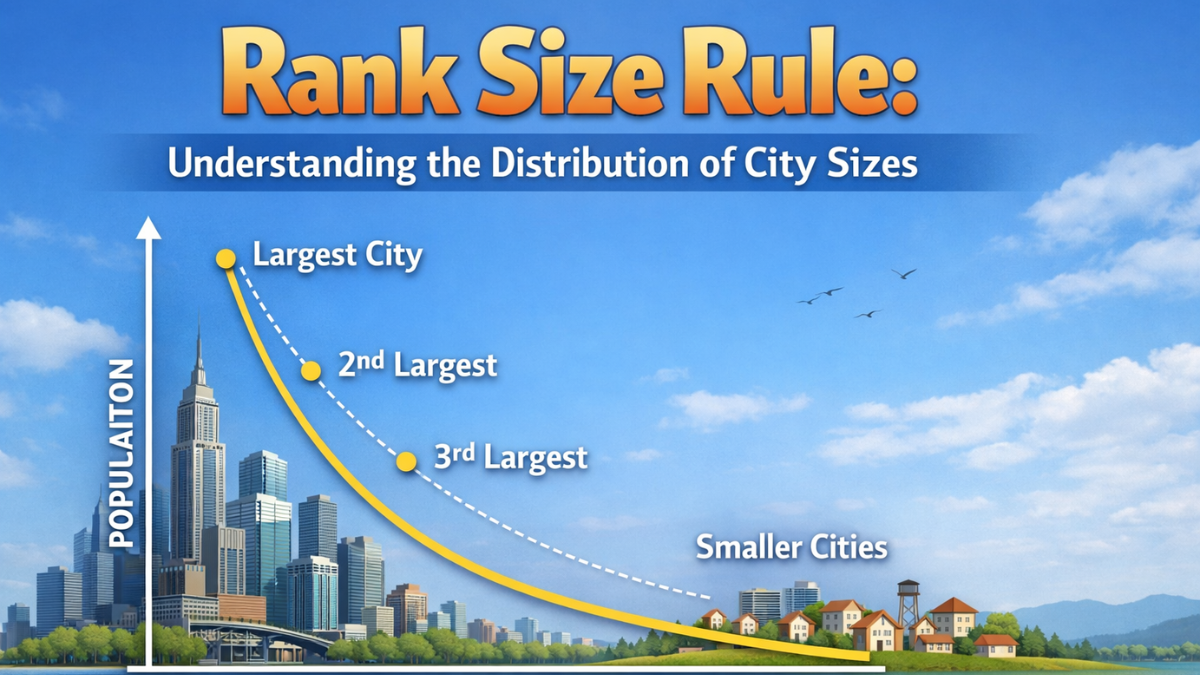
Cities across the world vary greatly in size, population, and influence. Some countries have one dominant megacity, while others have a more balanced system of urban centers. Urban geographers and economists study patterns that explain how cities grow and how their populations are distributed. One important concept used to understand this pattern is the Rank Size Rule.
The Rank Size Rule is a simple yet powerful idea that helps explain how city populations are distributed within a country or region. It suggests that the population of a city is related to its rank in the urban hierarchy. By examining this rule, researchers can better understand urban development, economic balance, and population distribution.
This article explains it in detail, including its definition, formula, examples, advantages, limitations, and real-world applications.
What Is the Rank Size Rule?
The Rank Size Rule is a concept in urban geography that explains the relationship between the population of a city and its rank in the list of cities within a country.
According to this rule, the population of a city is inversely proportional to its rank. In simple words, the second-largest city in a country will have about half the population of the largest city, the third-largest city will have about one-third the population of the largest city, and so on.
This rule is mainly used to describe the size distribution of cities in countries that have a well-balanced urban system.
Origin of the Rank Size Rule
The rank size rule was introduced by the American linguist and scholar George Kingsley Zipf in the 1940s. Zipf noticed that many natural and social phenomena follow similar distribution patterns.
His observation later became known as Zipf’s Law, which states that many types of ranked data follow a predictable mathematical pattern. In urban geography, Zipf applied this concept to city populations, leading to the development of it.
The Formula of the Rank Size Rule
The rank size rule can be expressed through a simple formula:
Pn = P1 / n
Where:
-
Pn = Population of the city with rank n
-
P1 = Population of the largest city
-
n = Rank of the city
Example
If the largest city has a population of 8 million, the expected populations according to the rule would be:
-
1st city = 8,000,000
-
2nd city = 4,000,000
-
3rd city = 2,666,667
-
4th city = 2,000,000
-
5th city = 1,600,000
This pattern continues as the rank increases.
How the Rank Size Rule Works
The rank size rule works by comparing the population of cities based on their order or rank in a country’s urban system.
To apply the rule:
-
List all cities in a country by population.
-
Assign a rank to each city (1 for the largest, 2 for the second largest, etc.).
-
Compare the actual population with the expected population based on the formula.
If the actual populations closely match the predicted values, the country is said to follow it.
Example of the Rank Size Rule in Real Life
Some countries show patterns that roughly follow the rank size rule. In these countries, there is a balanced distribution of urban development among several cities.
For example:
-
The largest city is large but not overwhelmingly dominant.
-
The second and third cities are also significant economic centers.
-
Development is spread across multiple regions.
Countries with developed transportation systems, strong regional economies, and balanced economic policies often show patterns similar to it.
Comparison with the Primate City Rule
To better understand it, it is helpful to compare it with another concept known as the Primate City Rule.
Rank Size Rule
-
Cities follow a predictable population pattern.
-
Urban development is balanced.
-
Several cities share economic importance.
Primate City Rule
-
One city dominates the entire country.
-
The largest city is much bigger than the second city.
-
Economic activity is concentrated in one urban center.
Many developing countries often follow the primate city pattern rather than it.
Importance of the Rank Size Rule
It is important for several reasons.
Understanding Urban Systems
It helps researchers analyze how cities are organized within a country. By studying city rankings, geographers can determine whether urban growth is balanced or uneven.
Urban Planning
Urban planners can use this rule to identify regions that need development. If one city is too dominant, governments may encourage investment in smaller cities.
Economic Analysis
Economists use the rule to study economic distribution. A balanced city system often indicates healthy economic development.
Population Studies
Demographers use it to understand migration patterns, urban expansion, and population growth.
Advantages of the Rank Size Rule
it offers several benefits when studying urban geography.
Simple to Understand
The concept is easy to explain and apply. It uses a straightforward mathematical relationship between rank and population.
Useful for Comparisons
Researchers can compare different countries and regions using the rule.
Helps Identify Urban Imbalance
If a country’s cities do not follow the rule, it may indicate economic or political imbalance.
Supports Policy Development
Governments can design policies to promote balanced urban growth based on the findings.
Limitations of the Rank Size Rule
Although it is useful, it also has several limitations.
Not Universal
Many countries do not follow the rule exactly. Urban development depends on history, geography, politics, and economics.
Ignores Local Factors
The rule does not consider factors such as natural resources, government policies, or cultural influences.
Changes Over Time
City populations change rapidly due to migration and economic development. As a result, the rank size distribution may shift.
Oversimplification
The rule simplifies complex urban systems into a mathematical formula, which may not fully reflect reality.
Factors Affecting City Size Distribution
Several factors influence whether a country follows it.
Economic Development
Countries with strong regional economies are more likely to have balanced city sizes.
Transportation Networks
Efficient transportation allows businesses and people to spread across multiple cities.
Government Policies
Decentralization policies can encourage development outside the largest city.
Geography
Natural features such as rivers, mountains, and coastlines can influence city growth.
Historical Development
Colonial history, industrialization, and political decisions also shape city distribution patterns.
Rank Size Rule in Urban Geography Studies
Urban geographers frequently use it when studying national and global city systems.
Researchers often create graphs called rank-size plots to visualize city population patterns. In these graphs:
-
The horizontal axis represents city rank.
-
The vertical axis represents population size.
If the cities follow the rule closely, the graph forms a straight line when plotted on a logarithmic scale.
This visualization helps researchers quickly identify whether a country follows it or a primate city pattern.
Real-World Applications
It have practical uses in many fields.
Urban Development Planning
Governments can plan infrastructure projects based on city size distribution.
Transportation Planning
Understanding city ranks helps planners develop efficient transportation networks.
Economic Forecasting
Economists use city population patterns to predict economic growth and investment opportunities.
Regional Development
The rule helps identify regions that may need additional economic support.
Modern Relevance of the Rank Size Rule
In the modern era, globalization and rapid urbanization have changed how cities grow. Mega cities are becoming more common, and population distribution patterns are evolving.
Despite these changes, it remains an important theoretical tool for understanding urban systems. It helps scholars analyze how cities develop and how economic activity spreads across regions.
With increasing urbanization worldwide, studying city size patterns will continue to be important for sustainable development and planning.
Conclusion
The Rank Size Rule is a fundamental concept in urban geography that explains how city populations are distributed according to their rank. It suggests that the population of a city is proportional to the population of the largest city divided by its rank.
This rule helps researchers analyze urban systems, compare countries, and understand patterns of economic development. While it provides valuable insights, it also has limitations because real-world city growth is influenced by many factors.
Even today, it remains an important framework for studying cities, urban planning, and regional development.
FAQs
What is the rank size rule in simple terms?
The rank size rule states that the population of a city is related to its rank among other cities. The second-largest city has about half the population of the largest city, the third-largest has about one-third, and so on.
Who developed the rank size rule?
The concept was introduced by George Kingsley Zipf in the 1940s as part of his research on patterns in human behavior and population distribution.
What is the formula for the rank size rule?
The formula is:
Pn = P1 / n
Where Pn is the population of the city with rank n, P1 is the population of the largest city, and n is the rank of the city.
Why is the rank size rule important?
It helps geographers, economists, and urban planners understand how cities grow and how population and economic activity are distributed across a country.
Do all countries follow the rank size rule?
No, not all countries follow this rule. Some countries have a primate city pattern where one city dominates the population and economy.
What is the difference between rank size rule and primate city rule?
It suggest balanced urban development among cities, while the primate city rule describes a situation where one city is much larger and more influential than the others.