

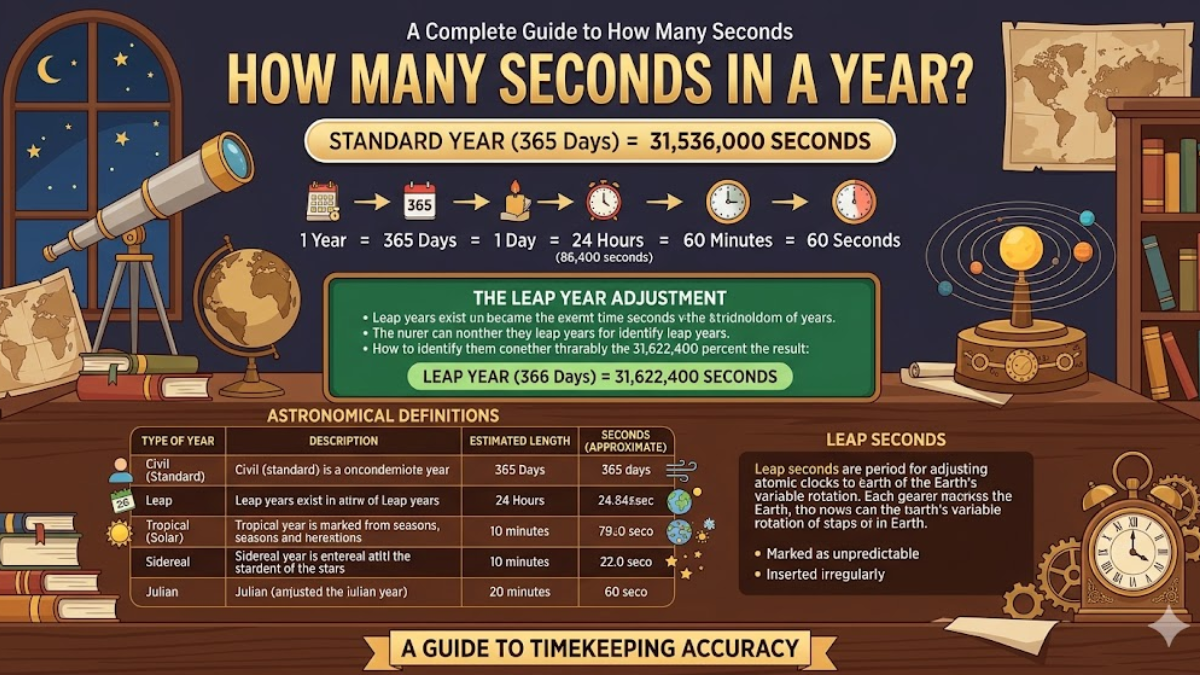
Time is one of the most fundamental aspects of our lives, yet we often overlook the details of how it is measured. One common question that sparks curiosity is: how many seconds are in a year? While the answer may seem simple at first, it actually depends on a few important factors, such as whether the year is a standard year or a leap year. In this article, we will explore the calculation in detail, explain the variations, and provide useful insights into how time works.
Understanding Time Measurements
Before calculating how many seconds are in a year, it’s important to understand the basic units of time. Time is typically measured in seconds, minutes, hours, days, and years. Each unit builds upon the previous one:
- 60 seconds = 1 minute
- 60 minutes = 1 hour
- 24 hours = 1 day
- 365 days = 1 year (standard year)
These units are universally accepted and used across the world. The second is the base unit of time in the International System of Units (SI), making it the starting point for all calculations.
How Many Seconds in a Standard Year?
A standard year consists of 365 days. To calculate the number of seconds in a year, we break it down step by step:
- Days in a year: 365
- Hours in a day: 24
- Minutes in an hour: 60
- Seconds in a minute: 60
Now multiply all these values:
365 × 24 × 60 × 60 = 31,536,000 seconds
So, in a standard year, there are 31,536,000 seconds.
How Many Seconds in a Leap Year?
A leap year occurs every four years to account for the extra fraction of a day in Earth’s orbit around the Sun. A leap year has 366 days instead of 365.
Using the same calculation:
366 × 24 × 60 × 60 = 31,622,400 seconds
So, in a leap year, there are 31,622,400 seconds.
Why Leap Years Exist
Leap years are necessary because the Earth takes approximately 365.25 days to complete one orbit around the Sun. Without adding an extra day every four years, our calendar would gradually fall out of sync with the seasons.
This small adjustment ensures that events like seasons, solstices, and equinoxes occur at roughly the same time each year. Over long periods, even a small difference in seconds can have significant effects.
Breaking Down the Calculation
Let’s simplify the calculation further for better understanding:
- One day = 24 hours
- One hour = 3,600 seconds (60 × 60)
So:
- One day = 24 × 3,600 = 86,400 seconds
Now multiply by the number of days:
- Standard year: 365 × 86,400 = 31,536,000 seconds
- Leap year: 366 × 86,400 = 31,622,400 seconds
This breakdown shows how each unit contributes to the final number.
Why Knowing Seconds in a Year Matters
You might wonder why this calculation is important. Understanding how many seconds are in a year has practical applications in various fields:
1. Science and Astronomy
Scientists use precise time measurements to track planetary motion, satellite orbits, and space missions.
2. Technology
Computers and software systems rely on time calculations for scheduling, timestamps, and data processing.
3. Finance
Interest calculations, investment growth, and financial modeling often depend on time-based formulas.
4. Personal Productivity
Knowing how time breaks down can help individuals manage their schedules more effectively and appreciate how quickly time passes.
The Concept of a “Tropical Year”
While we commonly use 365 or 366 days for calculations, the actual length of a year—called a tropical year—is about 365.2422 days. This slight difference is why leap years are introduced.
If we were to calculate seconds using the tropical year:
365.2422 × 86,400 ≈ 31,556,926 seconds
This value is often used in scientific contexts where precision is essential.
Seconds in Other Time Periods
To better understand the scale of time, let’s compare seconds in different durations:
- One minute: 60 seconds
- One hour: 3,600 seconds
- One day: 86,400 seconds
- One week: 604,800 seconds
- One month (average): ~2,628,000 seconds
- One year: 31.5 million seconds (approx.)
Seeing these comparisons helps put the number of seconds in a year into perspective.
Fun Facts About Seconds and Time
Time is fascinating, and here are a few interesting facts:
- A human heart beats about 2.5 billion times in an average lifetime, counting every second.
- Light travels about 300,000 kilometers in just one second.
- Even a tiny fraction of a second matters in high-speed sports like racing.
- Atomic clocks measure time with incredible precision, losing less than a second over millions of years.
How Time Perception Affects Us
While we can calculate time precisely, our perception of it varies. Sometimes a minute feels like an hour, while other times hours pass in what feels like seconds. This psychological aspect of time shows that while seconds are fixed, our experience of them is not.
Understanding how many seconds are in a year can also make us more mindful of how we spend our time. With over 31 million seconds in a year, each moment becomes valuable.
Practical Example: Daily Time Usage
Let’s consider how seconds add up in daily life. If you spend:
- 8 hours sleeping = 28,800 seconds
- 8 hours working = 28,800 seconds
- 8 hours on personal activities = 28,800 seconds
That’s a total of 86,400 seconds in a day. Over a year, these seconds accumulate into millions, highlighting how small daily habits can shape long-term outcomes.
The Importance of Precision in Timekeeping
Accurate timekeeping is essential in modern society. From GPS navigation to internet synchronization, precise measurement of seconds ensures everything runs smoothly. Even a one-second error can cause disruptions in systems that rely on exact timing.
This is why scientists continue to refine how we define and measure a second using atomic clocks.
Conclusion
So, how many seconds are in a year? The answer depends on the type of year:
- Standard year: 31,536,000 seconds
- Leap year: 31,622,400 seconds
While these numbers may seem large, they represent the countless moments that make up our lives. Understanding this breakdown not only satisfies curiosity but also helps us appreciate the value of time.
Whether you’re calculating for academic purposes, professional needs, or personal interest, knowing how time works at the level of seconds can be both practical and enlightening.
FAQs
1. How many seconds are in a regular year?
A regular year has 31,536,000 seconds, based on 365 days.
2. How many seconds are in a leap year?
A leap year contains 31,622,400 seconds, as it includes 366 days.
3. Why does a leap year have more seconds?
A leap year adds one extra day (February 29) to keep the calendar aligned with Earth’s orbit, resulting in more seconds.
4. How many seconds are in a day?
There are 86,400 seconds in a single day.
5. What is the exact number of seconds in a year scientifically?
Using the tropical year, there are approximately 31,556,926 seconds.
6. How often does a leap year occur?
A leap year occurs every four years, with some exceptions for century years.
7. Why is time measured in seconds?
The second is the base unit of time in the International System of Units, making it the most precise and standardized measurement.