

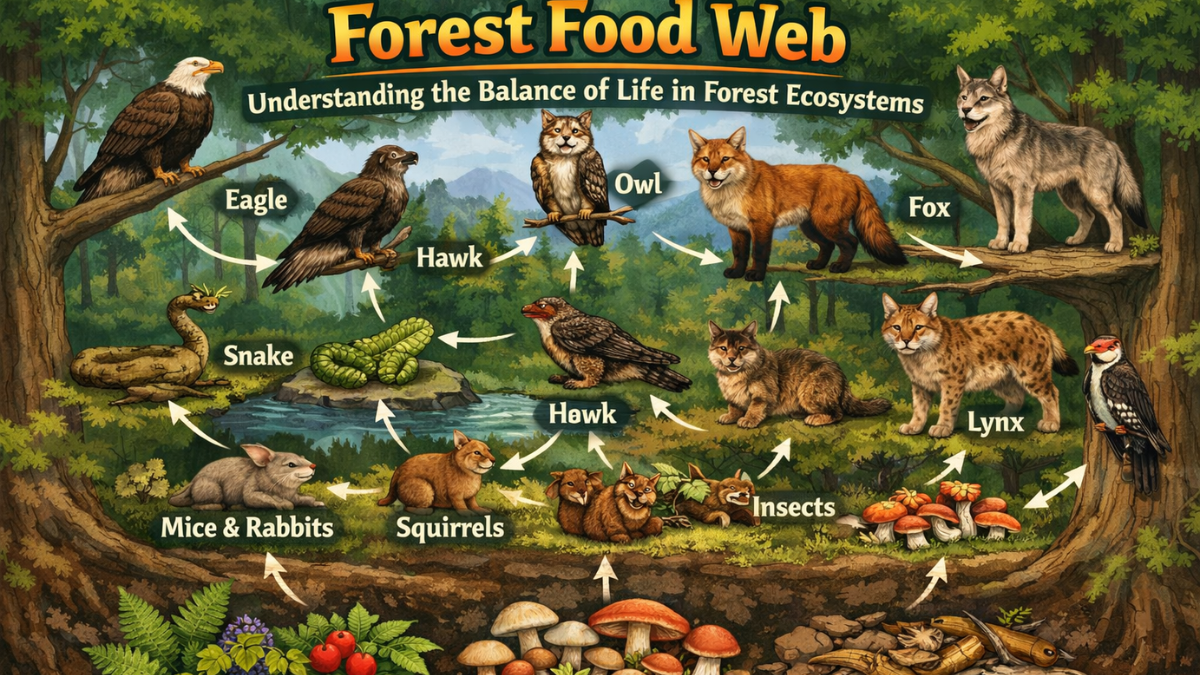
Forests are among the most complex and fascinating ecosystems on Earth. They are home to thousands of plant and animal species that interact with one another in many different ways. One of the most important concepts that helps us understand these interactions is the forest food web. A forest food web describes how energy and nutrients move through the forest ecosystem as organisms eat and are eaten by others.
Unlike a simple food chain, which shows a straight line of who eats whom, a food web is a complex network of interconnected food chains. In a forest, many organisms depend on multiple food sources, and each species plays a unique role in maintaining the balance of the ecosystem. Understanding the forest food web helps scientists, students, and nature lovers appreciate how life in forests is connected and why protecting these environments is essential.
What Is a Forest Food Web?
A forest food web is a system that shows how plants, animals, fungi, and microorganisms are connected through feeding relationships within a forest ecosystem. It illustrates how energy flows from one organism to another and how nutrients cycle through the environment.
In a forest food web, every living organism depends on others either directly or indirectly. Plants produce energy through photosynthesis, herbivores eat plants, carnivores eat herbivores, and decomposers break down dead organisms. This constant exchange of energy forms a web-like structure rather than a simple chain.
The complexity of the forest food web ensures stability. If one species declines, other species can sometimes fill its role. However, if too many species disappear, the balance of the entire ecosystem can be disturbed.
Key Components of a Forest Food Web
A forest food web consists of several important components. Each group of organisms plays a specific role in transferring energy throughout the ecosystem.
Producers
Producers are the foundation of the forest food web. These organisms create their own food using sunlight through the process of photosynthesis. They convert solar energy into chemical energy stored in plant tissues.
Common forest producers include trees, shrubs, grasses, mosses, and algae. Trees such as oak, pine, and maple are especially important because they provide food and habitat for many animals. Leaves, fruits, seeds, and nectar serve as food sources for herbivores.
Without producers, the entire food web would collapse because they provide the initial energy that supports all other life forms in the forest.
Primary Consumers
Primary consumers are herbivores that feed directly on producers. These animals rely on plants for their energy and nutrients.
Examples of primary consumers in forests include deer, rabbits, caterpillars, squirrels, and many insects. These organisms convert plant energy into a form that can be used by higher-level consumers.
Although they feed on plants, primary consumers are also important prey for carnivores. Their population size often influences the populations of predators that depend on them.
Secondary Consumers
Secondary consumers are animals that feed on primary consumers. Most of these animals are carnivores or omnivores.
Common secondary consumers in forests include frogs, small birds, snakes, foxes, and spiders. These predators help regulate herbivore populations, preventing them from overgrazing plants.
Secondary consumers play a crucial role in maintaining the balance of the forest ecosystem. By controlling herbivore numbers, they indirectly protect plant communities.
Tertiary Consumers
Tertiary consumers are top predators that feed on secondary consumers. They are usually larger animals and are often at the top of the food web.
Examples of tertiary consumers in forest ecosystems include wolves, eagles, owls, and large wild cats. These animals help keep populations of smaller predators and herbivores under control.
Top predators are extremely important for ecosystem stability. Their presence can influence the behavior and population sizes of many other species in the forest.
Decomposers
Decomposers are organisms that break down dead plants and animals. They recycle nutrients back into the soil, making them available for producers again.
Common decomposers in forest ecosystems include fungi, bacteria, earthworms, and certain insects. Without decomposers, dead organic matter would accumulate, and nutrients would not return to the soil.
Decomposition completes the cycle of energy and nutrients in the forest food web, ensuring that life continues to thrive.
Example of a Forest Food Web
To better understand how a forest food web works, consider a simple example. In a temperate forest, a tree produces leaves using sunlight. A caterpillar eats the leaves, gaining energy from the plant. A bird eats the caterpillar, and later an owl may eat the bird.
If the owl dies, decomposers such as fungi and bacteria break down its body and return nutrients to the soil. The tree then absorbs these nutrients through its roots, continuing the cycle.
In reality, the system is much more complex. A single caterpillar might be eaten by multiple predators, and the bird might feed on different insects. This interconnected network forms the true forest food web.
Importance of the Forest Food Web
The forest food web is essential for maintaining ecological balance. Each organism plays a role in transferring energy and maintaining population control.
When the food web is healthy, forests remain stable and productive. Plants grow efficiently, herbivore populations stay balanced, and predators maintain order within the ecosystem.
A well-functioning food web also supports biodiversity. Forests with diverse species tend to be more resilient to environmental changes, diseases, and natural disasters.
Energy Flow in the Forest Food Web
Energy enters the forest food web through sunlight. Producers capture this energy through photosynthesis and store it in their tissues. When herbivores eat plants, they obtain some of that energy.
However, energy transfer between levels is not perfectly efficient. Only a small portion of energy moves from one trophic level to the next. Most energy is lost as heat during metabolism.
This is why there are usually many plants, fewer herbivores, and even fewer predators in a forest ecosystem. The decreasing availability of energy limits the number of organisms that can exist at higher levels of the food web.
Role of Biodiversity in Forest Food Webs
Biodiversity refers to the variety of life within an ecosystem. In forests, biodiversity plays a major role in strengthening the food web.
When many species are present, the ecosystem becomes more stable. Different organisms can perform similar roles, meaning that if one species disappears, others may compensate for its absence.
For example, several insect species might feed on the same plant, and multiple bird species may prey on those insects. This diversity helps maintain balance within the food web and reduces the risk of ecosystem collapse.
Human Impact on Forest Food Webs
Human activities can significantly affect forest food webs. Deforestation, pollution, climate change, and habitat destruction can disrupt the delicate balance of these ecosystems.
When forests are cleared, producers disappear, removing the primary source of energy for the entire food web. This can cause herbivores and predators to decline or migrate to other areas.
Overhunting can also remove key predators, allowing herbivore populations to grow unchecked. This can lead to overgrazing and damage to plant communities.
Protecting forests is therefore essential for maintaining healthy food webs and preserving biodiversity.
Forest Food Web and Ecosystem Stability
A stable ecosystem depends on the strength and complexity of its food web. Forests with many interconnected species tend to recover more quickly from disturbances such as storms, fires, or disease outbreaks.
If one species declines, others may step in to maintain the balance. However, if too many species disappear, the food web can weaken and eventually collapse.
Scientists study forest food webs to understand how ecosystems function and how they can be protected for future generations.
Conclusion
The forest food web is a complex and interconnected system that supports life in forest ecosystems. From towering trees to tiny microorganisms, every organism plays a role in transferring energy and recycling nutrients.
Producers form the foundation of the food web, while consumers and decomposers help maintain balance and sustain life. Together, these organisms create a dynamic network that keeps forests healthy and productive.
Understanding forest food webs helps us appreciate the delicate balance of nature and highlights the importance of protecting forests. By preserving these ecosystems, we ensure that the intricate web of life continues to thrive for generations to come.
FAQs About Forest Food Web
What is a forest food web?
A forest food web is a network of feeding relationships among plants, animals, and microorganisms in a forest ecosystem. It shows how energy flows from producers to consumers and eventually to decomposers.
How is a food web different from a food chain?
A food chain shows a simple, linear path of energy transfer, while a food web shows multiple interconnected food chains. Food webs are more realistic because most organisms eat more than one type of food.
Who are the producers in a forest food web?
Producers are plants and other organisms that create their own food using sunlight. In forests, producers include trees, shrubs, grasses, and mosses.
Why are decomposers important in forest ecosystems?
Decomposers break down dead plants and animals, returning nutrients to the soil. This process helps plants grow and keeps the food web functioning.
What happens if a species disappears from the food web?
If a species disappears, it can disrupt the balance of the ecosystem. Predators may lose a food source, or prey populations may increase uncontrollably.
How do humans affect forest food webs?
Human activities such as deforestation, pollution, and climate change can damage forest ecosystems and disrupt the food web by removing species or altering habitats.