

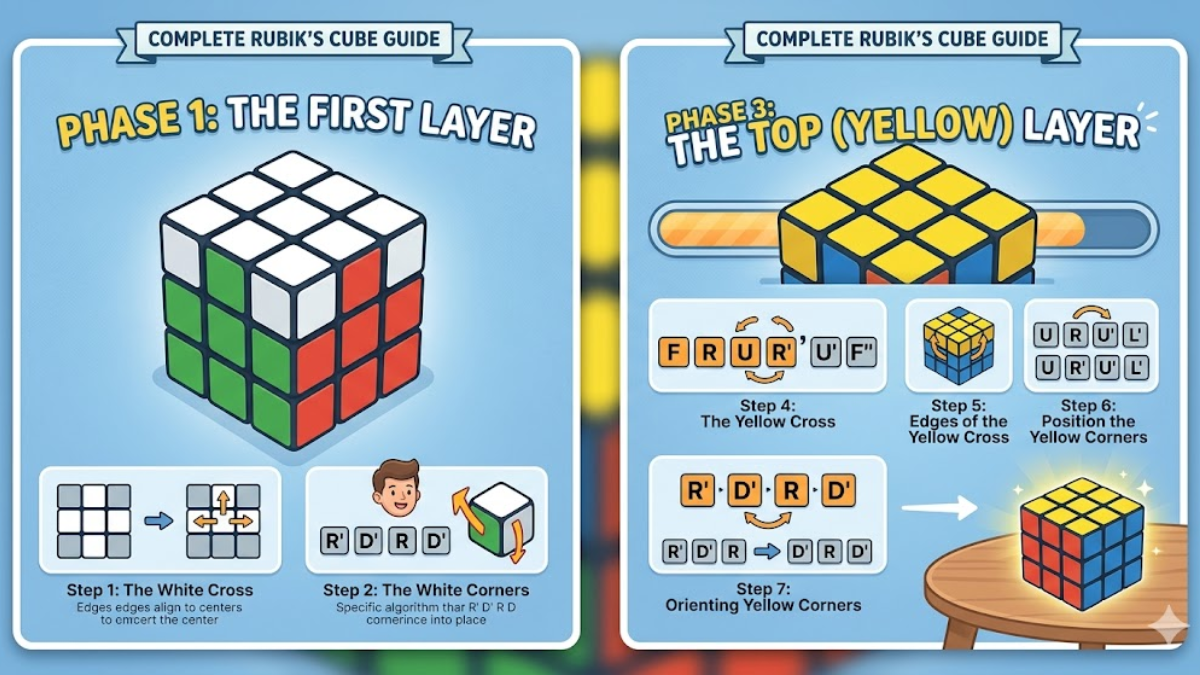
The Rubik’s Cube is one of the most iconic and fascinating puzzles in the world. At first glance, it may seem impossible to solve, with its colorful squares all mixed up. However, once you understand the logic and method behind it, solving a Rubik’s Cube becomes an enjoyable and even addictive challenge.
In this comprehensive guide, you will learn step-by-step how to solve a Rubik’s Cube using an easy beginner-friendly method. With patience and practice, you’ll be able to solve it confidently and even improve your speed over time.
Understanding the Basics of a Rubik’s Cube
Before jumping into solving the cube, it’s important to understand its structure. A standard Rubik’s Cube has six faces, each consisting of nine stickers of the same color when solved.
Each face rotates independently, and the cube is made up of three types of pieces:
- Center pieces: These define the color of each face and do not move relative to each other.
- Edge pieces: These have two colors.
- Corner pieces: These have three colors.
The key concept to remember is that the center pieces determine the final position of each color.
Learning the Notation System
To follow solving instructions, you need to understand basic cube notation:
- R: Right face clockwise
- R’: Right face counterclockwise
- L: Left face clockwise
- U: Upper face clockwise
- D: Down face clockwise
- F: Front face clockwise
- B: Back face clockwise
A letter with an apostrophe (’) means turning the face in the opposite direction.
Step 1: Solve the White Cross
Start by forming a white cross on the top face. This means placing four white edge pieces around the white center, matching the adjacent colors with their respective centers.
Focus on aligning each white edge piece correctly, not just forming the cross. This step builds the foundation for the entire solve.
Step 2: Complete the White Corners
Once the white cross is complete, the next goal is to place the white corner pieces in their correct positions.
Locate a white corner piece and position it below its intended spot. Use a simple sequence like:
- R’ D’ R D
Repeat this until the corner is correctly placed. Do this for all four corners until the entire white face is complete.
Step 3: Solve the Middle Layer
Now turn the cube so the white face is at the bottom. Your goal is to solve the middle layer edges.
Find an edge piece on the top layer that does not contain yellow. Align it with its matching center color. Then use one of these algorithms:
- To move it right: U R U’ R’ U’ F’ U F
- To move it left: U’ L’ U L U F U’ F’
Repeat this process until all middle layer edges are correctly placed.
Step 4: Create the Yellow Cross
Now focus on the top (yellow) face. Your goal is to form a yellow cross.
Depending on your current pattern, apply the following sequence:
- F R U R’ U’ F’
Repeat this until a yellow cross appears on the top face.
Step 5: Position the Yellow Edges
Once the yellow cross is formed, the next step is to align the yellow edge pieces with the center colors on the sides.
Use this algorithm:
- R U R’ U R U2 R’
Repeat until all yellow edges are correctly positioned.
Step 6: Position the Yellow Corners
Now you need to move the yellow corner pieces into their correct positions, even if they are not oriented properly yet.
Use the following sequence:
- U R U’ L’ U R’ U’ L
Repeat until all corners are in the right position.
Step 7: Orient the Yellow Corners
This is the final step. Rotate the yellow corners so that the entire cube is solved.
Use this sequence:
- R’ D’ R D
Apply it repeatedly to each corner until it is correctly oriented. Rotate the top layer to move to the next corner and repeat.
Eventually, all corners will align, and the cube will be solved.
Tips to Improve Your Solving Skills
Solving a Rubik’s Cube becomes easier with practice. Here are some tips to help you improve:
- Practice regularly to build muscle memory
- Learn algorithms gradually instead of memorizing everything at once
- Stay patient, especially in the beginning
- Watch your moves carefully to avoid unnecessary rotations
- Try solving without instructions once you’re comfortable
Common Mistakes to Avoid
Many beginners struggle because of simple errors. Here are a few to watch out for:
- Misaligning edge pieces during the white cross
- Using the wrong algorithm for a situation
- Rotating the cube incorrectly between steps
- Rushing without understanding each move
Taking your time to understand each step will make the process smoother.
Moving Beyond the Beginner Method
Once you’ve mastered the beginner method, you can explore more advanced techniques like:
- CFOP (Fridrich Method)
- F2L (First Two Layers)
- OLL (Orientation of Last Layer)
- PLL (Permutation of Last Layer)
These methods reduce the number of moves and significantly increase solving speed.
Why Learning to Solve a Rubik’s Cube is Beneficial
Solving a Rubik’s Cube is not just fun—it also offers several mental benefits:
- Improves problem-solving skills
- Enhances memory and concentration
- Develops patience and persistence
- Boosts spatial awareness
It’s a great activity for both kids and adults.
Frequently Asked Questions (FAQs)
1. How long does it take to learn to solve a Rubik’s Cube?
Most beginners can learn to solve the cube within a few days to a week with consistent practice. Mastery and speed-solving may take longer.
2. Is solving a Rubik’s Cube difficult?
It may seem difficult at first, but once you understand the steps and practice regularly, it becomes much easier.
3. Do I need to memorize all the algorithms?
Not at the beginning. Start with a few essential algorithms and gradually build your knowledge as you improve.
4. Can anyone learn to solve a Rubik’s Cube?
Yes, absolutely. Anyone with patience and willingness to learn can solve it, regardless of age.
5. What is the fastest way to solve a Rubik’s Cube?
Advanced methods like CFOP are the fastest, but beginners should start with the basic layer-by-layer method explained in this guide.
6. Why does my cube get messed up during solving?
This usually happens when an algorithm is performed incorrectly or a step is skipped. Double-check your moves and follow instructions carefully.
Final Thoughts
Learning how to solve a Rubik’s Cube is a rewarding journey that combines logic, memory, and persistence. While it may feel overwhelming at first, breaking it down into simple steps makes it manageable and enjoyable.
With practice, you’ll not only be able to solve the cube but also improve your speed and confidence. Over time, what once seemed impossible will become second nature.
So grab your cube, start practicing, and enjoy the process of mastering one of the world’s most famous puzzles!